
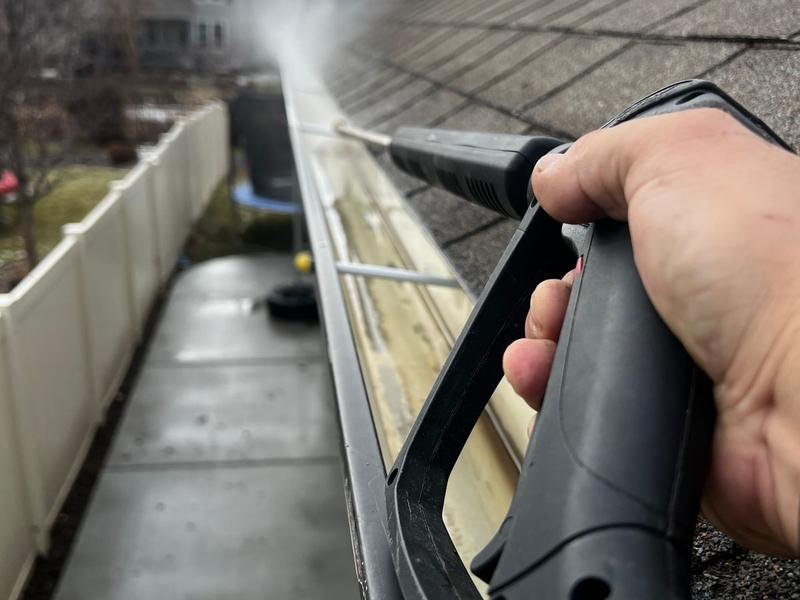
If you own a home in Bellevue, plan on cleaning your gutters at least twice a year: once in late fall after the bigleaf maples finish dropping, and once in spring after fir cones and catkins come down. Homes ringed by mature Douglas fir or western red cedar usually need a third look, because conifers shed needles every month of the year rather than all at once. Everything else — cost, access, how long the job takes — follows from the trees over your roof and the shape of your lot.
Why Bellevue gutters fill faster than you expect
Bellevue kept its tree canopy as it grew, and that is great for the neighborhoods and hard on the gutters. The debris here comes in layers:
- Douglas fir and western red cedar needles. Short, fine and constant. They slip through most coarse screens, pack down into a dense mat, and hold water like a sponge.
- Bigleaf maple and alder leaves. Maple leaves are huge and land in the fall in a rush. One windy night can shingle a whole gutter run.
- Cones and catkins in spring. Fir cones wedge into downspout openings, and alder catkins break into gritty fragments that travel to the lowest point and stop there.
- Roof moss and grit. Shaded north-facing roof slopes grow moss through the long wet season, and bits of it break loose and wash into the trough with granules from the shingles.
That mix matters because the fine stuff is what actually causes the overflow. A gutter full of whole maple leaves still passes some water. A gutter packed with wet fir needles and moss grit behaves like a planter box.
Somerset, Newport Hills and the hillside problem
Hillside neighborhoods are where Bellevue gutter work gets genuinely difficult. Somerset, Newport Hills, Cougar Mountain, Lake Hills and the slopes above Factoria share three traits that stack on each other:
- Height. Many homes are two stories at the front and three at the downhill side, so one elevation needs a long ladder on uneven ground.
- Slope. Ladder footing on a graded hillside yard is the real constraint. Where a ladder cannot be set safely, the work has to be done from the roof, and that changes the approach completely.
- Canopy. The firs that make these streets attractive are often taller than the house, dropping directly onto the roof instead of near it.
Flatter parts of the city — Crossroads, Northwest Bellevue, Wilburton, parts of West Lake Sammamish — are usually simpler: one or two stories, reachable gutter line, fewer conifers directly overhead. Same city, very different jobs. If you want a realistic number for your house, the fastest route is to request a free quote and describe the stories and the trees.
Timing through the Bellevue year
The wet season here runs from fall through spring with frequent drizzle and occasional heavy storms, so the goal is simple: have clear gutters before the big rain, and clear them again after spring drop.
Late fall is the priority visit
Late October through early December is the window that matters most. Deciduous drop is finished or nearly finished, and the strongest atmospheric-river storms of the season are still ahead. Cleaning before those storms is the difference between water leaving through the downspout and water sheeting over the front edge of the gutter onto a walkway.
Spring is the second visit
After the rains ease, cones, cedar debris and catkins need to come out. Skipping spring is the most common mistake on Eastside properties, because the spring load is the one that plugs downspout openings rather than filling the trough.
Mid-season checks for heavy conifer lots
If firs overhang the roof, look at the gutters after any windy stretch in January or February. You do not need a ladder for this — watch the gutter line during a hard rain from the ground. For what to look for, see the detail in signs of clogged gutters and the seasonal breakdown in when to clean gutters in Seattle.
What actually affects your quote
Providers price gutter work off the physical job, not off the city you live in. These are the levers:
- Linear feet of gutter. The single biggest factor. Big Bellevue lots often carry long roof runs, dormers, and detached garages or shops.
- Number of stories. Second- and third-story runs take more setup, more ladder moves, and more care.
- Roof pitch and surface. Steep or mossy roofs are slow to work from safely, and some simply should not be walked.
- Access and footing. Sloped yards, retaining walls, decks, hedges against the wall, and tight side-yard setbacks all add time.
- Debris volume and type. Packed wet needles and moss weigh far more and come out slower than dry leaves.
- Downspouts. How many, and whether they need to be opened up or flushed.
- Existing gutter guards. Removing and reinstalling covers to clean underneath adds labor. If you are weighing covers, read gutter guards in the Pacific Northwest first.
- Extras bundled in. Hauling debris away, rinsing the trough, wiping gutter faces, or adding roof moss work.
When you compare quotes, confirm the same scope in each one. "Gutter cleaning" sometimes means debris removal only, and sometimes means debris removal plus downspout flushing plus haul-away. Ask, too, whether the provider carries liability insurance for ladder and roof work — that is a fair question on any two-story Bellevue home.
Underground drain lines: the Bellevue wrinkle
Plenty of Bellevue homes, especially on the hillsides, route downspouts into buried pipes that carry water downhill and away from the foundation. Those lines collect needle grit and fine sediment, and they fail quietly. The symptom is not a dripping gutter — it is water backing up at the base of the downspout, or a soggy patch in the lawn above where the pipe runs, or water pooling against a foundation wall after a storm.
Clearing the gutter does nothing for a plugged underground line, so treat them as two separate questions. There is more on diagnosing this in clogged downspouts in Seattle.
Moss is part of the same job
Shaded roof slopes under Bellevue's canopy hold moisture long enough to grow moss through the wet months, and that moss sheds into the gutters continuously. Moss also lifts shingle edges and traps needles that would otherwise blow off. If your gutters refill quickly with dark gritty sludge rather than recognizable leaves, the roof is the source — see roof moss in gutters, and consider whether roof moss removal belongs in the same visit.
Safety, honestly
Wet moss on a Bellevue roof is as slick as ice, and a hillside yard rarely gives a ladder level footing. If your home is two stories, if the roof is steep, or if the ladder has to stand on a slope, retaining wall, or deck rail, that is the point to hand the job to someone with the right ladders and fall protection. Single-story homes on flat ground with easy footing are a reasonable DIY afternoon — a bucket, a scoop, gloves, and a hose. Never lean out sideways from a ladder to reach another few feet; move the ladder.
Ready for a quote?
Tell us the stories, the roof pitch, and what is growing over the house, and you will get a number that reflects your actual property instead of an average. This site is a free quote-request service that passes your details to an independent local provider — compare gutter cleaning in Bellevue with the general gutter cleaning in Seattle page, or request a free quote now and get ahead of the next storm.